[Rédacteur]
[Propriétaire MU Média – MetalUniverse.net]
Entrevue avec Aeveris
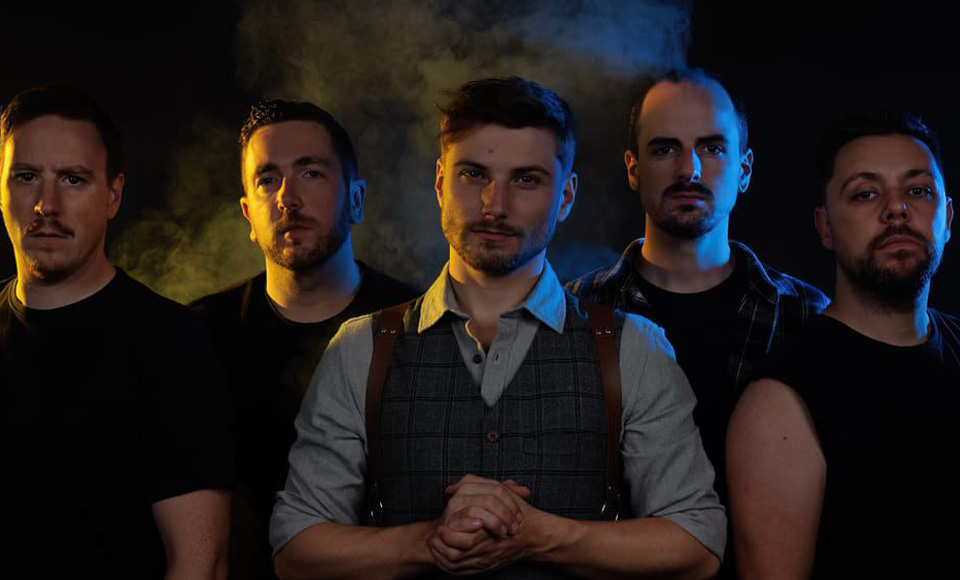
Après avoir attiré l’attention avec White Elephant, le groupe metalcore/modern metal belge Aeveris est de retour avec Imminence, un projet ambitieux divisé en deux chapitres : Act I: Roots et Act II: Revelations. À travers ces deux volets, la formation explore des thèmes profondément humains comme les attentes, la pression, l’isolement et la résilience, tout en proposant un son à la fois plus lourd, plus mélodique et plus mature.
Nous avons discuté avec le groupe afin d’en apprendre davantage sur la création de Imminence, son concept, l’arrivée de nouveaux membres et les prochaines étapes de l’aventure Aeveris.
[ english follows ]
(MU) Tout d’abord, félicitations pour la sortie de Imminence. En regardant le chemin parcouru depuis White Elephant jusqu’à Imminence, comment sentez-vous qu’Aeveris a évolué, autant musicalement que personnellement?
(Aeveris) Merci! Quelques changements ont été apportés. Comme vous le savez, nous avons un nouveau chanteur ainsi qu’un nouveau guitariste. Musicalement, je dirais que Imminence est un peu plus mature que White Elephant. Je suis très fier du fait que les gens semblent considérer cet album comme étant à la fois lourd et mélodique.
(MU) Plutôt que de sortir le projet complet d’un seul coup, vous avez choisi de diviser Imminence en deux chapitres : Act I: Roots (sorti le 6 février 2026) et Act II: Revelations (sorti le 22 mai 2026). Pour les lecteurs qui découvrent Aeveris pour la première fois, pouvez-vous expliquer le concept derrière chacun de ces chapitres et la façon dont ils se complètent pour former l’expérience complète de Imminence?
(Aeveris) L’idée derrière le fait de diviser l’album en deux actes était de montrer le contraste ainsi que le lien entre deux « phases » d’un même problème. Une chanson de l’Acte I parle du problème lui-même, tandis que la chanson correspondante de l’Acte II traite des conséquences lorsqu’on essaie de résoudre ce problème ou de composer avec celui-ci.
Prenons par exemple Gravity, dans l’Acte I. Cette chanson parle du poids des attentes et de la pression extérieure qui vous écrase alors que vous tentez de vous élever afin d’atteindre vos objectifs et vos rêves.
Dans l’Acte II, la chanson And Then There Were None parle des conséquences du fait d’avoir réussi à traverser cette pression qui vous retenait au sol (la gravité) et de finalement la dépasser. Vous avez réussi à franchir l’atmosphère et à vous libérer de cette pression. Mais une fois arrivé au sommet, vous réalisez qu’il vous était impossible d’emmener tout le monde ou tout ce qui vous entourait avec vous. Vous laissez donc certaines personnes ou certaines choses derrière vous, prisonnières de cette gravité, conséquence de vos ambitions personnelles.
(MU) Qu’est-ce qui a motivé la décision de sortir Imminence sous la forme de deux actes distincts plutôt que comme un album complet traditionnel? Est-ce que ce format permettait de raconter l’histoire plus efficacement?
(Aeveris) L’idée derrière cette décision était de nous assurer que les gens prennent le temps d’écouter et d’assimiler les chansons du premier acte afin de pouvoir s’y identifier. En procédant ainsi, nous pensons que les morceaux du second acte créent un meilleur lien, puisque les auditeurs ont eu le temps de bien connaître les premières chansons avant de découvrir celles qui leur répondent.
(MU) Act I: Roots met l’accent sur les attentes extérieures, le fait de rester fidèle à soi-même et le rejet. Ces thèmes sont-ils inspirés d’expériences personnelles vécues au sein du groupe ou plutôt d’observations du monde qui vous entoure?
(Aeveris) Tout l’album est principalement basé sur mes expériences personnelles et mes émotions (Wouter). Bien sûr, il y a également certaines observations que j’ai faites du monde qui m’entoure dans ce contexte. J’ai volontairement généralisé certains aspects afin que chacun puisse s’y reconnaître plus facilement, mais nous voulions écrire sur des choses qui nous semblaient vraies et authentiques, dans l’espoir de mieux connecter avec ceux qui écoutent notre musique.
(MU) Act II: Revelations explore l’isolement dans un monde de plus en plus connecté ainsi que le sentiment grandissant de frustration collective. Pourquoi était-il important pour Aeveris d’aborder ces sujets?
(Aeveris) Je (Wouter) voulais écrire sur ces sujets pour une raison très simple : ces problèmes sont extrêmement répandus et tout le monde doit y faire face d’une manière ou d’une autre.
Malheureusement, plusieurs de ces sujets sont rarement abordés ou même remarqués, puisque la souffrance dont nous parlons est mentale et invisible. Même les personnes les plus fortes physiquement peuvent ressentir exactement la même douleur sur le plan psychologique.
En écrivant sur ces sujets et en partageant mes pensées et mes émotions, j’espère créer un lien avec les personnes qui écouteront ces chansons et leur donner le sentiment qu’elles ne sont pas seules à vivre ces émotions ou ces pensées.
(MU) À la suite du départ du chanteur Louis Soenens et du guitariste Dennis Wyffels à la fin de 2023, Wouter van Kerschaver et Dempsey Derous ont rejoint le groupe. Comment leur arrivée a-t-elle influencé le son et la direction créative d’Aeveris?
(Aeveris) (Jeffrey) Wouter est un chanteur extrêmement polyvalent provenant d’un univers complètement différent, ce qui a vraiment permis aux chansons de prendre vie d’une toute nouvelle façon.
Dempsey est tout simplement un musicien très solide. Il apporte un jeu de guitare remarquable ainsi qu’une oreille extrêmement affûtée au groupe. C’est aussi quelqu’un avec qui il est très agréable d’échanger des idées. L’arrivée de ces deux nouveaux membres a clairement fait évoluer le groupe dans la bonne direction. En plus, ce sont deux personnes avec qui il est vraiment plaisant de travailler.
J’avais écrit la majorité de White Elephant pratiquement seul, au moins 90 % de ses fondations. Notre batteur Louis Van Der Linden avait déjà apporté quelques idées, mais sur Imminence, ma contribution représente davantage environ 75 %. J’ai donc très hâte de voir ce que l’avenir nous réserve.
(MU) Les nouvelles compositions semblent plus rapides, plus lourdes et plus techniques, tout en laissant davantage de place à la mélodie et à l’émotion. Cette évolution s’est-elle faite naturellement ou était-ce un objectif conscient dès le départ?
(Aeveris) (Jeffrey) Je pense que c’était une évolution naturelle. J’essaie toujours de créer un bon mélange de chansons; un album est toujours un exercice d’équilibre. Naturellement, je suis attiré par les morceaux rapides et lourds, mais dans n’importe quelle chanson, c’est toujours la mélodie qui finit par vous accrocher. Ayant grandi en écoutant des groupes comme Arch Enemy et Trivium, les aspects à la fois « lourds et techniques » ainsi que « mélodiques » font profondément partie de moi comme auteur-compositeur.
Le fait que Dempsey partage sensiblement les mêmes influences aide énormément lui aussi. Louis a réalisé un travail exceptionnel derrière la batterie sur cet album, tandis que la voix de Wouter apporte une émotion brute qui contribue au sentiment d’urgence et de puissance qui se dégage de Imminence.
(MU) Votre premier album, White Elephant, a reçu d’excellentes critiques, vous a permis de jouer au Alcatraz Festival ainsi que d’assurer une première partie pour Fleddy Melculy. Est-ce que le succès de cet album a créé une pression supplémentaire au moment de travailler sur son successeur?
(Aeveris) Un album semble toujours représenter un énorme défi lorsqu’on commence à le créer. Heureusement, j’écris constamment de nouvelles idées, alors je ne manque jamais de matériel sur lequel travailler.
(MU) Aeveris puise son inspiration auprès de groupes comme Lamb of God, Killswitch Engage, Slipknot, At The Gates et Trivium. Quelles influences sont les plus perceptibles sur Imminence, et y a-t-il eu de nouvelles inspirations qui se sont invitées dans le processus d’écriture?
(Aeveris) Je crois que ces influences sont toujours présentes d’une façon ou d’une autre. Si vous prenez le temps d’analyser les chansons en profondeur, vous pourriez dire : « Ah, ce riff pourrait très bien se retrouver sur un album de Slipknot. »
Cette fois-ci, nous avons porté énormément d’attention aux structures des chansons, afin de nous assurer qu’elles soient de véritables chansons et non simplement une collection de riffs. Le fait d’avoir Dempsey avec nous et qu’il participe à l’écriture aide énormément. Il a naturellement apporté son propre style au groupe. En réalité, nos approches se complètent très bien.
(MU) Chaque album possède généralement une chanson qui représente parfaitement l’état d’esprit d’un groupe à un moment précis de son parcours. Si vous deviez choisir une seule pièce de Imminence qui définit le mieux Aeveris en 2026, laquelle serait-ce et pourquoi?
(Aeveris) (Jeffrey) Honnêtement, c’est difficile à dire. Je pense que notre identité transparaît dans chacune des chansons que nous composons. Mais si je devais en choisir une, je dirais And Then There Were None, simplement parce qu’elle contient presque tout ce que nous faisons : un excellent refrain, des couplets rapides et assez techniques.
(MU) Le titre Imminence évoque un sentiment d’urgence ainsi que l’impression que quelque chose d’important approche. Que représente ce titre pour vous et comment reflète-t-il les thèmes explorés à travers les deux actes?
(Aeveris) Nous voulions utiliser le mot Imminence précisément pour cette sensation que quelque chose d’inévitable approche, sans savoir quand cela arrivera ni de quoi il s’agira exactement. Ça pourrait ne pas arriver avant plusieurs années… mais ça pourrait tout aussi bien arriver dans la prochaine heure. Malheureusement, nous savons tous avec une certitude absolue que quelque chose de difficile finira par nous arriver un jour. Cela fait partie de la vie, et c’est quelque chose que nous devons accepter et apprendre à ne pas craindre.
Parce que ce sont justement ces moments douloureux qui ferment un chapitre de notre vie pour en ouvrir un autre. Parfois pour le pire, mais parfois aussi, avec le recul, pour le meilleur. Même si, sur le moment, cela ne semble absolument pas être le cas.
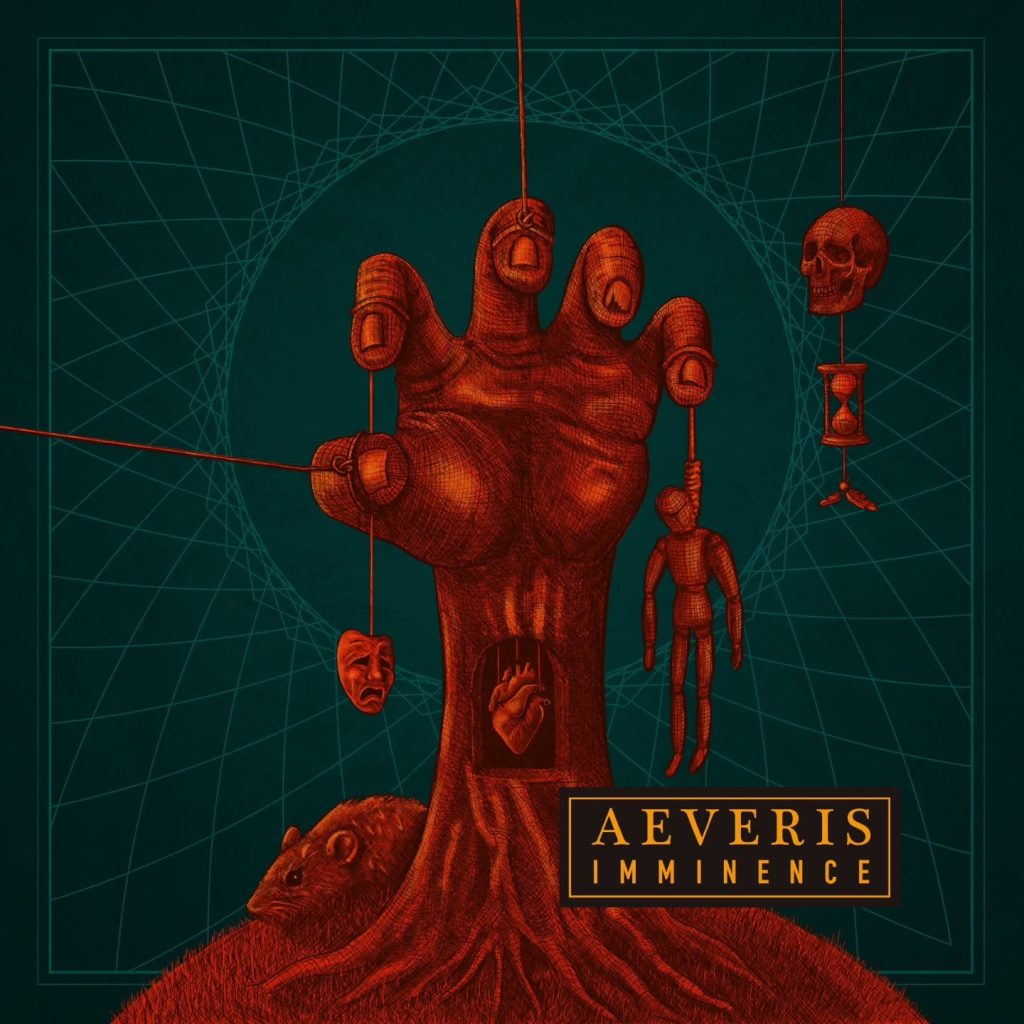
Liste des pièces Imminence:
Act I: Roots
- The Mask
- Gravity
- Theft Of Time
- Downfall
- Show Me Your Weakness
Act II: Revelations
- The Ghost Inside
- And Then There Were None
- Quicksand
- Sheep Who Suffer
- Tendrills Of Regret
(MU) Y a-t-il eu une chanson, sur Act I ou Act II, qui s’est révélée particulièrement difficile à écrire, à arranger ou à enregistrer?
(Aeveris) (Jeffrey) Les chansons plus lentes sont toujours les plus difficiles (Theft of Time étant la plus lente). Une fois que nous avions trouvé le refrain, cela a naturellement orienté toute la chanson dans la bonne direction. Aussi, The Mask a connu pas moins de onze versions différentes, donc celle-là nous a demandé beaucoup de temps. Au final, elle est devenue l’une des chansons les plus intenses que nous ayons jamais sorties.
Parfois, il est difficile de sortir de l’étape de la démo. Ce n’est réellement que lorsque Louis enregistre ses parties de batterie définitives sur une chanson que nous avons enfin le sentiment de nous rapprocher de la version finale.
(MU) Depuis la sortie des nouveaux morceaux, quelle a été la réaction des fans? Certaines chansons vous ont-elles surpris par la façon dont le public s’y est attaché?
(Aeveris) Nous avons reçu d’excellentes critiques! J’ai l’impression que les gens sont encore en train d’assimiler notre changement complet de formation, mais j’entends énormément de commentaires positifs concernant Wouter. J’ai aussi été surpris de voir à quel point And Then There Were None fonctionne bien en spectacle. Pourtant, c’est sans doute l’une de nos chansons les plus simples, ce qui démontre qu’être plus technique ne signifie pas nécessairement être meilleur.
(MU) Maintenant que les deux chapitres de Imminence sont disponibles, quels sont les prochains objectifs d’Aeveris? Les fans peuvent-ils s’attendre à une importante tournée, à des festivals, à de nouveaux vidéoclips ou peut-être même à une première visite au Canada?
(Aeveris) L’écriture de notre troisième album est déjà commencée. Nous avons hâte de jouer sur de plus grandes scènes, d’assurer les premières parties de groupes encore plus importants et de traverser de nouvelles frontières. J’adorerais venir au Canada.
(MU) Merci beaucoup pour votre temps aujourd’hui. Avant de conclure, y a-t-il autre chose que vous aimeriez dire à nos lecteurs ainsi qu’à tous ceux qui découvriront Aeveris grâce à MetalUniverse.net?
(Aeveris) (Jeffrey) Je dirais : donnez une chance à l’album, écoutez-le quelques fois et laissez-nous un message sur YouTube. Cheers!
(Wouter) J’aimerais remercier tout le monde d’avoir pris le temps d’écouter notre musique. J’espère avoir réussi à créer un lien avec au moins une personne et peut-être même à l’aider à traverser son problème ou sa situation. Ce n’est pas la dernière fois que vous entendrez parler de nous, alors restez à l’écoute!
▶ Écoute/Stream/Commande de l’album « Imminence »:
https://distrokid.com/hyperfollow/aeveris/imminence-act-ii
Spotify: https://open.spotify.com/intl-fr/album/6xB1
Le nouvel EP Imminence (Act II: Revelations) est sorti le 22 mai 2026.
Facebook : www.facebook.com/aeveris
Instagram : www.instagram.com/aeveris.band
Playlist YouTube:
ENGLISH version
MU: First of all, congratulations on the release of Imminence. Looking back at the journey from White Elephant to Imminence, how do you feel Aeveris has evolved as a band both musically and personally?
Aeveris: Thank you! Some changes were made, as you well know, we have a new vocalist and a new guitarplayer. Musically I’d say Imminence is a bit more mature than White Elephant. I’m very proud of the fact that people seem to feel that it’s both a heavy and a melodic record.
MU: Instead of releasing the entire project at once, you chose to split Imminence into two chapters: Act I: Roots (released on February 6, 2026) and Act II: Revelations (released on May 22, 2026). For readers discovering Aeveris for the first time, can you explain the concept behind each chapter and how they connect to form the complete Imminence experience?
Aeveris: The thought behind splitting the album in 2 acts was to show a contrast and connection between to “phases” of a common issue. a song in Act 1 would be about the issue and Act 2 would be about the consequences when trying to fix or deal with that problem. Take for example “Gravity” in Act 1. This song is about feeling the weight of expectations and the external pressure pushing you down in trying to “rise” to the occasion and reaching your goals and dreams. In Act 2, the song “And then there were none” is about the consequence of trying push through that pressure keeping you down (gravity) and finally getting beyond it. You have made it through the atmosphere and escaped the pressure. But now that you’ve made it, you notice you couldn’t possibly take everyone or everything with you, leaving them behind in that gravity as a consequence of your personal ambitions.
MU: What motivated the decision to release Imminence as two separate acts rather than as a traditional full-length album? Did this format help tell the story more effectively?
Aeveris: The thought behind this decision was to make sure that people got to listen and internalize the songs from act 1 and give them some time to “relate” with them. In doing so, we think the songs from act 2 will connect better since the listeners got some time to get to know the first songs and link them with the 2nd songs following them up.
MU: Act I: Roots focuses on outside expectations, staying true to yourself and dealing with rejection. Were these themes inspired by personal experiences within the band or by observations of the world around you?
Aeveris: The whole album is generally based on my personal experiences and feelings (Wouter). And off course some observations made of the world around me in that context. I generalized them a bit to make it more relatable to everyone, but we wanted to write about things that felt real and genuine. In hopes of better connecting with our listeners in the process.
MU: Act II: Revelations explores isolation in an increasingly connected world and the growing sense of collective frustration. Why was it important for Aeveris to address these topics?
Aeveris: I (Wouter) wanted to write about these topics for the simple fact that these issues are extremely common and something everyone has to deal with in some shape or form. But sadly enough, not all these topics are often talked about or seen since the pain we are writing about is mental and invisible. Even the strongest people physically can have the same amount of pain mentally. In writing about these topics and sharing my thoughts and feelings about them, I hope to connect with the people who listen to the songs and give them a feeling of not being alone in those feelings or thoughts.
MU: Following the departure of vocalist Louis Soenens and guitarist Dennis Wyffels in late 2023, Wouter van Kerschaver and Dempsey Derous joined the band. How did their arrival influence the sound and creative direction of Aeveris?
Aeveris: (Jeffrey) Wouter is a very versatile vocalist coming from an entirely different background, this certainly helped bring the songs to life in an entirely new way. Dempsey is just a solid guy, bringing solid guitarplaying and a very sharp ear to the band. He’s a great dude to bounce ideas off of. So having two new people in the band definitely nudged things in the right direction. They also happen to be two people that are fun to work with. I wrote the majority of White Elephant on my own, at least 90% of the foundation of it. There was already some input from Louis Van Der Linden, our drummer, but on Imminence my part was more like 75%. So I’m eager to see what the future holds.
MU: The new material feels faster, heavier and more technical, while also showcasing more melody and emotion. Was that evolution something that happened naturally, or was it a conscious goal from the beginning?
Aeveris: (Jeffrey) I think it was a natural evolution. I always try to make a nice mix of songs, an album is always a balancing act. I naturally lean towards fast and heavy songs, but in any song it’s always the melody that really gets you hooked. Growing up on bands like Arch Enemy, Trivium, both ‘heavy and technical’ and ‘melodic’ are e strong part of me as a songwriter. Dempsey coming from roughly the same background helps as well. Louis really put down some great drumming on this album, Wouter’s vocals just have a raw emotion to it, it just all contributes to the sense of urgency and heaviness on Imminence.
MU: Your debut album White Elephant earned strong reviews, a spot at Alcatraz Festival and a support slot for Fleddy Melculy. Did the success of that album create additional pressure while working on its successor?
Aeveris: An album always seems like a huge undertaking when you start it. Luckily I’m always writing stuff so there’s never a shortage of something to work on. It’s so natural to me that, at least in that sense, I didn’t feel more pressure to come up with better songs. The thought of ‘yeah now we’re going to have to top what we did on white elephant’ did cross my mind though. Finding a new vocalist and new guitarist did help in broadening our options musically. There’s a lot more input nowadays. The most of White Elephant was written when the band did not really exist yet, so now having to work with more people is very rewarding. It does seem to be paying off, we’re playing a bigger stage at Alcatraz and still have some cool shows the coming year.
MU: Aeveris draws inspiration from bands such as Lamb of God, Killswitch Engage, Slipknot, At The Gates and Trivium. Which influences are most noticeable on Imminence, and were there any new inspirations that found their way into the writing process?
Aeveris: I guess these influences are always there in one way or another. If you really dissect the songs, you could say ‘Oh that riff could go on a Slipknot-album’. This time around we paid a lot of attention to song structures, making sure the songs were actually good songs instead of a collection of riffs. Having Dempsey aboard and assisting the writing does help. He really naturally brought his own style to the band. We actually are pretty complementary.
MU: Every album usually has one song that perfectly represents where a band is at a specific moment in time. If you had to choose one track from Imminence that best defines Aeveris in 2026, which one would it be and why?
Aeveris: (Jeffrey) Hard to say actually, I think it shines through in every song we make. If I’d had to choose I’d say ‘And then there were none’, just because it has almost everything we do in it, it has a great chorus, fast technical’ish verse.
MU: The title Imminence suggests a sense of urgency and the feeling that something significant is approaching. What does the title mean to you, and how does it reflect the themes explored throughout the two acts?
Aeveris: We wanted to use the word ‘imminence’ because of that sense of feeling something unavoidable approaching and not knowing when or what it will be. It might not happen for years, but it also just might happen in the next coming hour. Sadly enough we all know with 100% certainty that « something » bad will come our way eventually. It’s a part of life, and it’s something we must accept and learn not to fear. Cause it’s those moments of pain that close one chapter of life, and start another. Sometimes for the worse, but sometimes, in the long run also for the better. Even if it doesn’t feel like it at that exact moment.
MU: Was there a particular song on either Act I or Act II that proved especially challenging to write, arrange or record?
Aeveris: (Jeffrey) The slower ones are always the thoughest (Theft of time being the slower one), once we had the chorus down, that kind off put the whole song in the right direction. Also ‘The Mask’ had 11 versions, so that one took some time. It turned out to be one of the most intense songs we’ve ever put out. Sometimes it’s hard to get out of that demo-stage, it’s only really when Louis puts his definitive drums on a song that we get the feeling that we’re closer to finishing it.
MU: Since the release of the new material, what has been the reaction from fans? Have there been any surprises regarding which songs people have connected with the most?
Aeveris: We got some good reviews! I get the feeling people are still processing our whole line-up change, but I hear a lot of positive things about Wouter. I was surprised to see that ‘And then there were none’ really vibes with the crowd live, it’s an arguably simpler song, which goes to show that more technical isn’t always better I guess.
MU: Now that both chapters of Imminence have been released, what are the next goals for Aeveris? Can fans expect extensive touring, festival appearances, new videos or perhaps a first visit to Canada in the future?
Aeveris: Writing for album three is already underway. We’re looking forward to playing some bigger stages, support bigger acts and crossing some borders. I’d love to come to Canada.
MU: Thank you very much for your time today. Before we wrap things up, is there anything else you would like to say to our readers and to everyone discovering Aeveris through MetalUniverse.net?
Aeveris: (Jeffrey) I’d say give the album a couple of spins, drop us a line on youtube. Cheers!
(Wouter) I would like to thank everyone for listening and I hope I got to connect with at least one person and maybe even helped them in getting through their problem or situation. This isn’t the last thing you will hear form us, so stay tuned!